
Quick Answer
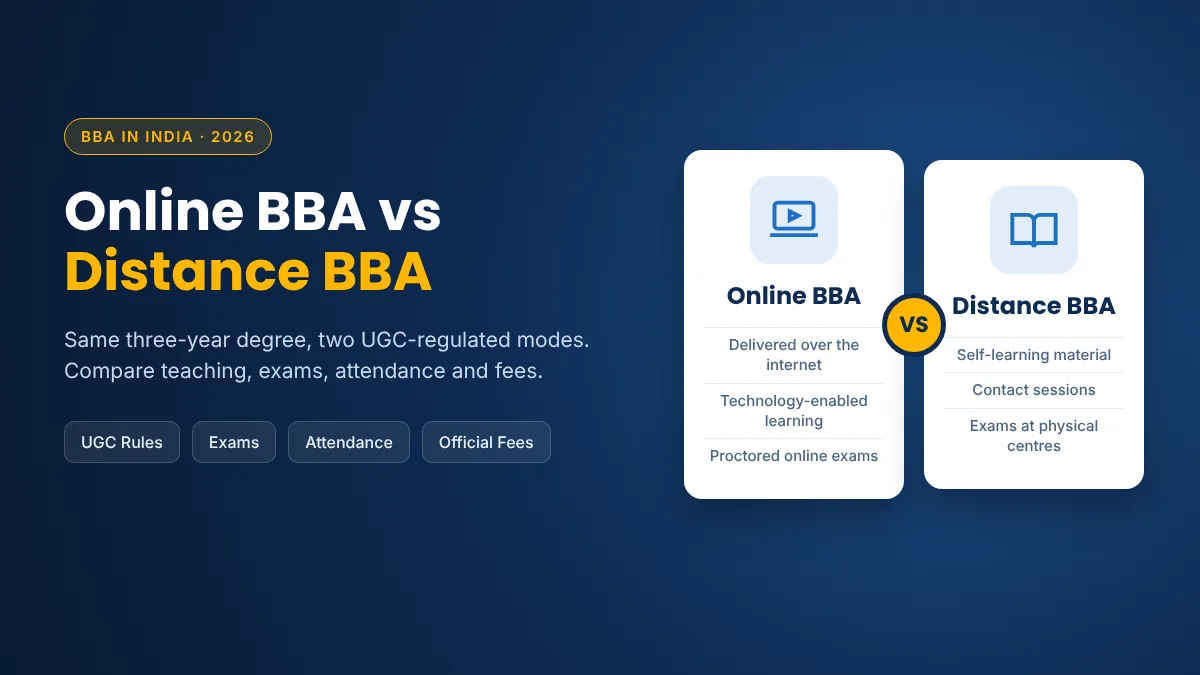
An online BBA and a distance BBA are two separate modes under the UGC’s 2020 regulations. A distance (ODL) BBA relies on self-learning material, contact sessions and exams at physical centres within the university’s permitted area. An online BBA is delivered fully over the internet, with technology-enabled or proctored exams. Both lead to a three-year BBA that UGC treats as equivalent to a regular degree, if the university is listed for your session.
Key Highlights
- A distance learning BBA and an online BBA are both legal routes to the same three-year degree, but UGC regulates them as two different modes with different rules for teaching, attendance and exams.
- The UGC’s 2014 Specification of Degrees lists the BBA as a bachelor’s degree with a minimum duration of three years and an entry qualification of 10+2.
- Distance BBA exams are held at physical centres inside the university’s territorial jurisdiction; online BBA exams are technology-enabled or proctored, and can be taken from home where the university allows.
- Official online BBA fees at the nine universities we checked on 29 October 2026 range from ₹90,000 (Sikkim Manipal University) to ₹1,99,000 (Amity Online) for three years, before discounts.
- The mode of delivery must be printed on the back of every degree certificate and mark sheet, so your BBA will show whether it was earned online or by distance.
What is the difference between an online BBA and a distance BBA?
The difference is the mode of delivery, and in India that is a legal category, not a marketing label. The UGC (Open and Distance Learning Programmes and Online Programmes) Regulations, 2020 define the two modes separately and set different rules for each.
Open and Distance Learning mode, which is what “distance BBA” or “correspondence BBA” usually means today, is described in the regulations as education through a variety of media with occasional interactive face-to-face meetings. In practice you study from self-learning material, attend some contact sessions and write your exams at a centre.
Online mode is described as full-fledged programme delivery through the internet. Classes, study material, assignments and examinations all happen through the university’s digital platform.
Both modes sit under the same set of UGC online and ODL regulations, and both are permitted only for universities that the University Grants Commission has approved for that mode and that programme. If you have read our comparison of the online MBA vs distance MBA, the logic is the same for the BBA. The only things that change are the degree level, the eligibility and the universities that offer it.
Why the word “correspondence” still shows up
Many people still search for a “BBA correspondence course”. The word comes from the era when study material was posted to students and assignments were posted back. The current regulations do not use “correspondence” as a separate mode. If a university advertises a correspondence BBA today, ask it directly whether the programme is listed in ODL mode or online mode, because those are the only two categories the UGC-DEB lists recognise.
Online BBA vs distance BBA: the side-by-side comparison
Here is how the two modes compare on the points that usually decide the choice. Regulatory points come from the UGC 2020 regulations; fee figures come from the official university pages listed later in this article.
| Point | Distance (ODL) BBA | Online BBA |
| How you learn | Self-learning material plus occasional contact sessions | Fully internet-based: live and recorded classes on an LMS |
| Attendance rule before exams | 75% attendance in the Personal Contact Programme | 75% participation in all online activities |
| Where exams happen | Proctored exams at physical centres within the university’s territorial jurisdiction | Technology-enabled online tests or proctored exams |
| Where you can study from | Activities stay within the university’s permitted territory | Anywhere in India, and outside India for many programmes |
| Who may offer it | Universities meeting the ODL route in Regulation 3(A) | Universities meeting the online routes in Regulation 3(B) |
| Degree and duration | BBA, minimum three years | BBA, minimum three years |
| Equivalence | Equivalent to a regular BBA under Regulation 22 | Equivalent to a regular BBA under Regulation 22 |
| Mode printed on certificate | Yes, on the back of the certificate and mark sheets | Yes, on the back of the certificate and mark sheets |
| Typical official fee (checked 29 Oct 2026) | Not verified from official pages for this article | ₹90,000 to ₹1,99,000 for three years at the universities we checked |
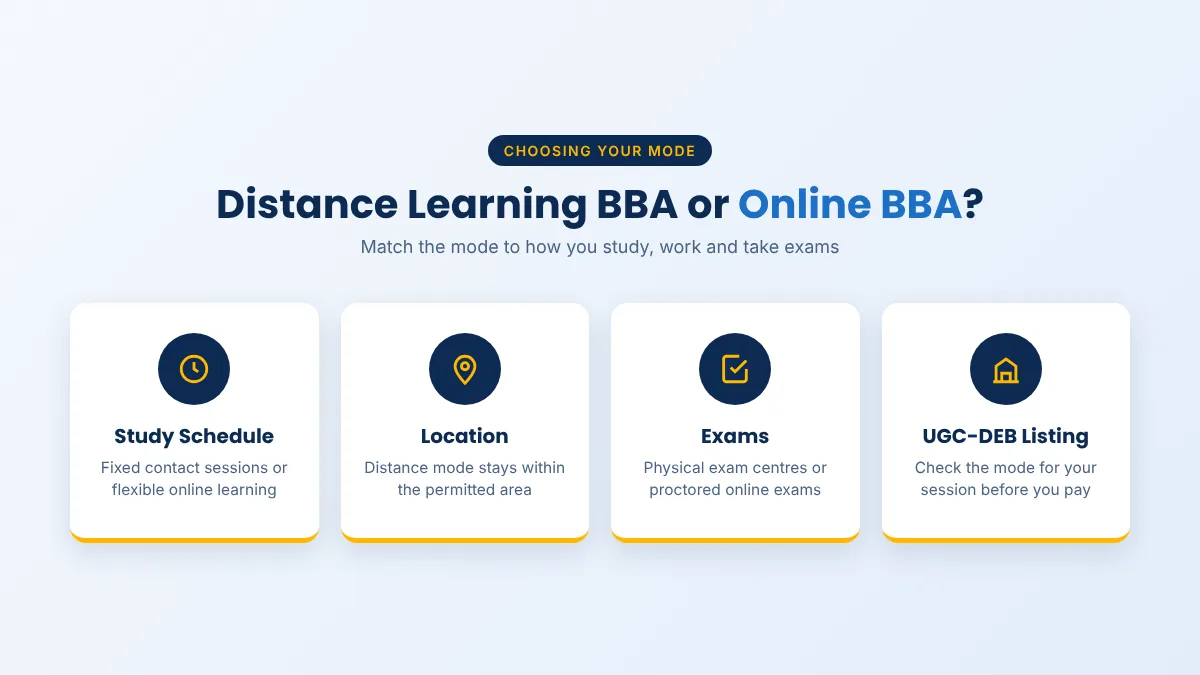
Neither column is “better” in general. A distance BBA rewards strong self-study habits and suits someone who is comfortable travelling to an exam centre. An online BBA suits someone who wants structured live sessions and wants to take exams from home where the university permits.
How does a distance learning BBA work?
A distance learning BBA is built around self-learning material, with face-to-face contact kept to scheduled sessions. You receive the material, study on your own timetable, submit assignments and attend contact programmes at the university’s headquarters or approved centres.
Three regulatory points shape the experience.
First, attendance. The regulations require 75% attendance in the Personal Contact Programme, not counting counselling sessions, before you can sit the term-end exams. If your job makes it hard to attend scheduled contact days, plan for this before you enrol.
Second, exams. ODL term-end exams are proctored at examination centres within the university’s territorial jurisdiction. The regulations require safeguards at these centres such as CCTV, biometric authentication and an observer, and they do not allow private centres to be used. You travel to the centre to write the paper.
Third, geography. Under the 2020 regulations, private universities run ODL programmes only from their headquarters and approved off-campus centres, and state and private universities stay within their own state. If you live in another state, a particular university’s distance BBA may simply not be open to you, or your exam centre may be far away.
On assessment, the regulations cap continuous assessment at 30% and require the term-end examination to carry at least 70% of the marks. Most of your result therefore depends on the exams you write at the centre.
How does an online BBA work?
An online BBA runs entirely on the university’s learning platform. You watch recorded lectures, join live sessions, read e-content, post in discussion forums and submit assignments online. The universities we checked describe formats such as “LIVE + Recorded” classes (LPU) and live online sessions with asynchronous learning (ARKA JAIN).
The rules differ from ODL in a few important ways.
Attendance becomes participation. Before term-end exams, you need 75% participation in the programme’s online activities rather than attendance at contact days.
Exams are technology-enabled or proctored. Sikkim Manipal University, for example, states that its online BBA term-end exams are computer-based and online proctored from home, and that a Windows PC or laptop with the latest Google Chrome is required because its secure exam browser does not run on iOS. LPU describes “Flexible Online Exams”. Other universities list online exams without giving full details, so ask about device requirements and exam windows before you pay.
There is no territorial restriction for online programmes, which is why a student in Assam can enrol in an online BBA from a university in Rajasthan or Punjab.
The assessment split is the same as ODL: at most 30% continuous assessment and at least 70% term-end. Our guide to studying MBA online explains how the learning platform, live classes and proctored exams work week to week, and almost all of it applies to an online BBA too.
Is a distance BBA valid in India?
Yes, a distance BBA is valid when the university and the programme are listed by UGC-DEB for ODL mode for your admission session. The same is true of an online BBA in online mode.
Regulation 22 of the 2020 regulations says that undergraduate and postgraduate degrees awarded through ODL or online mode by recognised institutions, in conformity with the 2014 Specification of Degrees, are treated as equivalent to the corresponding degrees earned in conventional mode.
The BBA itself is a specified degree. The UGC’s 2014 Specification of Degrees, published in the Gazette of India on 5 July 2014, lists the BBA (Bachelor of Business Administration) at entry 34 as a bachelor’s level degree with a minimum duration of three years and an entry qualification of 10+2. Every online BBA we checked runs for three years over six semesters.
One more detail matters for your future. Regulation 16(2) makes it mandatory for universities to print the mode of delivery, the date of admission, the date of completion and the exam centres on the back of every degree certificate and mark sheet. So your BBA will state whether it was earned online or by distance. That is not a problem in itself, because equivalence applies to both, but it does mean you should choose the mode honestly rather than hoping nobody will notice. Our comparison of the online MBA certificate vs degree explains what appears on an online degree certificate in more detail.
Individual employers and government recruitment notices can set their own eligibility conditions, so if you are aiming at a specific job, read that notice as well.
Which universities offer an online BBA, and what do they charge?
Nine universities we checked publish an online BBA, and their official fees differ by more than double. All figures below were taken from the universities’ own pages on 29 October 2026. Where a page did not print a total, the multiplication is ours and is labelled.
| University | UGC-DEB 2026-27 (online) | Fee per semester | Total for three years | Extras stated on the page | Official page |
| Sikkim Manipal University | Entitled, BBA listed | ₹15,000 | ₹90,000 (₹81,000 with 10% full-payment discount) | Application fee ₹500 | SMU online BBA (onlinemanipal.com) |
| GLA University | Entitled, BBA listed | ₹14,750 plus ₹1,500 exam fee | ₹99,500 all inclusive | Registration ₹2,000 (included in all-inclusive figure) | GLA online BBA |
| ARKA JAIN University | Recognised, BBA listed | ₹17,500 | About ₹1,16,500 with registration and exam fees (our calculation) | Registration ₹2,500; exam fee ₹3,000 per year | ARKA JAIN online BBA |
| NMIMS | Entitled, BBA listed | ₹25,000 (₹30,000 with Business Analytics electives) | ₹1,31,000 one-time (₹1,45,000 with Business Analytics) | Processing ₹1,200; exam ₹800 per subject per attempt | NMIMS online BBA admission |
| Manipal University Jaipur | Entitled, BBA listed | ₹24,000 | ₹1,44,000 | Application fee ₹500 | MUJ online BBA (onlinemanipal.com) |
| Lovely Professional University | Entitled, BBA listed | ₹25,000 actual (₹20,400 with 20% grant until 31 Oct 2026) | ₹1,50,000 at the actual fee (our calculation) | Registration ₹1,000; exam fee ₹2,000 per semester included | LPU online BBA |
| Chandigarh University | Entitled, BBA listed | Not stated at list price | ₹1,75,000 list | Seat booking ₹10,000 | CU online BBA |
| UPES | Entitled, BBA listed (confirm the variant) | Not published | Not published | No-cost EMI mentioned | UPES online BBA |
| Amity University (Uttar Pradesh) | Entitled, BBA (General) listed | ₹33,200 | ₹1,99,000 list; ₹1,75,120 if paid one-time | EMI ₹7,877 per month for 24 months | Amity online BBA |
UGC-DEB status comes from the 2026-27 entitled universities list and the 2026-27 recognised universities list. These are scanned PDFs with columns that run into each other, so open the list yourself and find the university’s row for your admission session before you apply.
Notes on individual universities
Sikkim Manipal University has the lowest list fee in this comparison. Its page states 120 credits, a maximum of six years to finish, online proctored term-end exams, and specializations in Business Analytics and FinTech, Entrepreneurship, Operations and Supply Chain Management, and Banking and Insurance. It mentions no-cost EMI from ₹2,500 a month, available only on the annual fee, and scholarships of up to 30% for eligible categories.
GLA University prints an all-inclusive figure of ₹99,500, which matches its tuition of ₹88,500, exam fees of ₹9,000 and registration of ₹2,000. It also lists a ₹3,000 benefit on full-fee payment. Its electives cover marketing, human resource, finance, entrepreneurship and family business, and banking and insurance.
ARKA JAIN University is on the UGC-DEB recognised list, not the entitled list, for its BBA and MBA (General), with recognition running from the February 2025 session to July-August 2029. Recognised status is legitimate for the programmes listed. Its specializations are Finance, Marketing and HR.
NMIMS requires 50% in 10+2 (45% for SC, ST, OBC and PwD candidates), which is the clearest minimum percentage we found among these programmes. You pay ₹10,000 of the programme fee at registration.
Manipal University Jaipur lists 126 credits and seven elective areas, including Digital Marketing, Data Analytics and Retail and E-Commerce. Its page showed 29 October 2026 as the last date of admission for the current intake. If marketing is your main interest, compare the online BBA in marketing and the BBA in digital marketing options.
Lovely Professional University shows an actual fee of ₹25,000 per semester and a 20% Student Grant that brings it to ₹20,400, valid until 31 October 2026. If you apply after that date, plan on the actual fee.
Chandigarh University lists ₹1,75,000 and a 25% early bird scholarship that its page says closed on 14 October, without a year. It lists the widest choice of specializations of any programme here, from Marketing and Fin-Tech to Healthcare Management and Event Management.
Amity University Online is the most expensive at list price. It offers tracks such as Data Analytics, Data Science, Travel and Tourism Management and a BBA plus MBA option. Its page asks for Class 10 and Class 12 certificates but does not state a minimum percentage.
UPES lists a minimum of 45% in Class 12 but did not publish a fee or duration on the page we checked. Ask its admissions team for a written fee schedule.
Which universities offer a BBA in distance mode?
Distance BBAs are offered by universities on the UGC-DEB ODL list, which is a separate document from the online lists. The 2026-27 ODL programme list includes a Bachelor of Business Administration at, for example, Andhra University and Bharati Vidyapeeth.
We have not quoted distance BBA fees in this article because we could not confirm them from official university fee pages on the day we checked. Fee figures for distance programmes circulate widely on aggregator sites, and they often disagree with one another. Before you pay, ask the university for its official fee notification for the current session, including registration, examination and study-material charges.
Remember the territorial rule when you shortlist. A state university’s distance BBA is normally open only within its state, and a private university’s distance BBA runs only from its headquarters and approved off-campus centres. An online BBA has no such restriction.
How much does an online BBA really cost?
The real cost is the semester fee plus everything the semester fee does not include. Here are four worked examples using only the official figures above.
Example 1: Sikkim Manipal University, paying in full
- Course fee: ₹90,000
- 10% full-payment discount: ₹81,000
- Application fee: ₹500
- Total by our calculation: ₹81,500, assuming no resits
Paying semester by semester instead would cost ₹90,000 plus the ₹500 application fee. The discount is worth ₹9,000 if you have the cash upfront.
Example 2: ARKA JAIN University
- Tuition: ₹17,500 x 6 semesters = ₹1,05,000
- Registration: ₹2,500
- Exam fee: ₹3,000 x 3 years = ₹9,000
- Total by our calculation: about ₹1,16,500
The headline semester fee is low, but the extras add more than ₹11,000.
Example 3: Lovely Professional University, grant or no grant
- With the 20% grant: ₹20,400 x 6 = ₹1,22,400, plus ₹1,000 registration = ₹1,23,400
- At the actual fee: ₹25,000 x 6 = ₹1,50,000, plus ₹1,000 registration = ₹1,51,000
Both totals are our calculation. The grant on the page runs until 31 October 2026, and the page does not say whether it applies to all six semesters, so ask before you budget on it.
Example 4: NMIMS, semester-wise or one-time
- Semester-wise: ₹25,000 x 6 = ₹1,50,000 (our calculation)
- One-time: ₹1,31,000
- Add the ₹1,200 processing fee and ₹800 for every subject attempt
Exam fees here depend on the number of subjects and on whether you pass each paper first time, so ask NMIMS how many subjects the programme has before you compare it with a flat-fee programme.
For the same kind of breakdown for another undergraduate degree, see our online BCA course fees comparison.
Who should choose a distance BBA, and who should choose an online BBA?
Choose by how you learn, where you live and how much structure you need, not by which mode sounds more modern.
A distance BBA tends to suit you if:
- You are disciplined enough to study mostly from printed or digital self-learning material.
- You live within the university’s permitted territory and can reach its contact sessions and exam centre.
- You prefer writing exams in a hall rather than on a proctored laptop at home.
An online BBA tends to suit you if:
- You want scheduled live classes and recordings to keep you on track.
- You live far from any campus, move cities often, or work shifts that make fixed contact days difficult.
- You have, or can arrange, a laptop and a stable internet connection that meet the university’s exam requirements.
If you have just finished Class 12, think honestly about motivation. Three years of self-study with few fixed sessions is hard at 17 or 18. Some students in that position find the structure of live online classes easier to keep up with, while others prefer the calmer pace of a distance programme. If you are already working, the deciding factor is usually whether you can reach an exam centre during exam weeks.
Can you do a BBA online or by distance straight after Class 12?
Yes. A BBA is an undergraduate degree, and the 2014 Specification of Degrees sets 10+2 as its entry qualification. The universities set any minimum percentage themselves, because UGC lets institutions specify qualifications where it has not prescribed them.
Here is what the official pages say:
| University | Eligibility stated on the official page |
| NMIMS | 10+2 in any discipline with at least 50% (45% for SC, ST, OBC and PwD) |
| UPES | At least 45% in Class 12, or a three-year diploma after Class 10 with 45% |
| Chandigarh University | 10+2 or equivalent in any stream; no minimum percentage stated |
| Manipal University Jaipur | 10+2 from a recognised board, or a 10+3 diploma; no minimum percentage stated |
| Sikkim Manipal University | 10+2 from a recognised board, or a 10+3 diploma; no minimum percentage stated |
| ARKA JAIN University | Pass in 10+2 from any recognised board |
| Amity University | Class 10 and Class 12 certificates; no minimum percentage stated |
| LPU and GLA | Minimum percentage not stated on the pages we checked |
If you do not yet have a degree and are really looking for an MBA, a BBA is the route that gets you there. Our guide on whether you can do an MBA without a bachelor’s degree explains why a three-year bachelor’s degree comes first.
What can you do after an online or distance BBA?
A BBA from a UGC-listed university, in either mode, is a bachelor’s degree, so it opens the same next steps as a regular BBA. The most common one for BBA graduates is a postgraduate management programme. Our overview of the types of MBA in India compares full-time, online, distance and executive formats, and the online MBA fees comparison shows what the next degree costs at the same universities.
Some universities also offer a combined route. Amity’s online BBA page lists a “BBA + MBA” track. If that interests you, ask exactly which two degrees you receive, when each is awarded, and whether both appear on the UGC-DEB list.
Red flags in online and distance BBA marketing
Most BBA advertising is honest, but a few patterns should make you pause.
| What you see | Why it is a concern | What to ask |
| “Correspondence BBA” with no mention of ODL or online | The UGC-DEB lists only recognise ODL and online modes | Which mode is it listed under, and for which session? |
| A distance BBA offered far outside the university’s state | ODL programmes have territorial limits | Is my location within your permitted area? Where is my exam centre? |
| A BBA “in one or two years” | The 2014 Specification sets a three-year minimum for the BBA | What exact award will I receive, and from which institution? |
| A company, not the university, collecting fees or issuing the degree | UGC does not allow franchise arrangements with private service providers | Will I pay the university directly and receive a receipt in its name? |
| A promise that the certificate will not mention online or distance | Regulation 16(2) requires the mode to be printed on the back | Can I see a sample degree certificate and mark sheet? |
| A badge that says “UGC approved” with no link to the list | Approval is per programme and per session | Can you send me the DEB list showing this BBA for my session? |
How to check whether a BBA is online or distance on the UGC-DEB list
You can confirm the mode yourself in about ten minutes. The UGC’s own public notice on admission precautions asks students to make these checks before taking admission.
- Open deb.ugc.ac.in and find the session-wise lists of recognised programmes.
- For an online BBA, open the “OL Entitled” or “OL Recognised” list for your session. For a distance BBA, open the ODL list.
- Find the university by its legal name and the state it is in. The lists are grouped by state.
- Check that “Bachelor of Business Administration”, in the exact variant you are applying for, appears against that university.
- Check the university’s own website for its UGC application and approvals, as the notice advises.
- Keep a copy of the list page for your records.
Our step-by-step guide to checking UGC approved online programmes walks through the same process, using the MBA as the example.
If you would like help comparing the online BBA fees, eligibility and exam formats above against your own situation, an admission advisor can go through the official fee schedules and UGC-DEB listings with you before you apply.
How GetOnlineDegree.in Helps
We compare online programmes from universities that appear on the UGC-DEB lists, using each university’s own fee and eligibility pages rather than third-party estimates. When you speak to us about a BBA, we can show you the official fee schedule for your shortlist, point you to the university’s line on the DEB list for your session, and explain the practical difference between the online and distance options you are considering. The decision about which mode and which university suits you stays with you. You can browse our partner universities to see which programmes each one offers.
Conclusion
The choice between a distance learning BBA and an online BBA is really a choice about how you want to study, not about the value of the degree. Both modes lead to a three-year BBA that UGC treats as equivalent to a regular one, and both print the mode on your certificate.
A distance BBA gives you self-paced study with contact days and hall-based exams, but it is tied to the university’s territory. An online BBA gives you live and recorded classes and exams you can usually take from home, with no geographic limit. Official online BBA fees at the universities we checked run from ₹90,000 to ₹1,99,000, and the extras can change the real total by several thousand rupees.
Whichever way you lean, confirm the university and the exact BBA on the UGC-DEB list for your session, get a written fee schedule, and ask how and where you will write your exams.
FAQs
Is a distance BBA valid for jobs in India?
Yes, if the university and the BBA are listed by UGC-DEB in ODL mode for your admission session. Regulation 22 of the UGC 2020 regulations treats ODL and online degrees from recognised institutions as equivalent to regular degrees. Specific employers and government recruitment notices can set their own conditions, so read the notice for any job you target.
Which is better, an online BBA or a distance BBA?
Neither is better in every case. A distance BBA suits disciplined self-learners who live within the university’s area and can reach an exam centre. An online BBA suits people who want live classes, live far from campuses or work shifts. Both lead to the same three-year degree, so choose by how you study best.
What is the minimum duration of a BBA through distance or online mode?
Three years. The UGC’s 2014 Specification of Degrees lists the BBA as a bachelor’s degree with a minimum duration of three years and an entry qualification of 10+2. Under the 2020 regulations the maximum time to complete is double the minimum, and some universities, such as Sikkim Manipal University, state a six-year limit.
Will my BBA certificate mention online or distance?
Yes. Regulation 16(2) of the UGC 2020 regulations requires universities to print the mode of delivery, along with admission and completion dates and exam centres, on the back of every degree certificate and mark sheet. Equivalence applies regardless, so the printed mode does not reduce the degree’s validity.
What is the cheapest online BBA among UGC-listed universities?
Among the nine universities we checked on 29 October 2026, Sikkim Manipal University had the lowest list fee at ₹90,000 for three years, or ₹81,000 with its full-payment discount. GLA University lists ₹99,500 all inclusive. Always add application, registration and exam fees, and confirm current offers before paying.
